EMLF Interview

Tsubasa Arakawa:
Hello. My name is Tsubasa Arakawa, and I’m the head of EMLF.
Today, I’d like to introduce Rapunzel Electronics, who has released a large number of works through my label, EMLF, over the years.
The mixing and mastering for his new EP, scheduled for release on Friday, September 25, have now been completed. I’m very happy with how it has turned out.
So, without further ado, I’d like to talk with Rapunzel Electronics about a variety of topics.
First of all, could you briefly introduce yourself?
Introduction
Rapunzel Electronics:
Sure. I’m already a fairly middle-aged guy, and I never really know what I’m supposed to say when someone asks me to introduce myself. It’s surprisingly difficult.
I make music.
Some people may know me under the band name Kawasaki Onkyo Service. I worked under that name for quite a while, but the band hasn’t really been active recently, so these days I make techno as a solo artist under the name Rapunzel Electronics.
My name is Suzuki. Nice to meet you.
Tsubasa Arakawa:
Thank you.
Next, I’d like to ask about the kind of activities you’ve been involved in as an artist over the years.
Previous Activities
Rapunzel Electronics:
Honestly, I don’t really have anything grand enough to call a career.
I think I only played live once or so before the COVID pandemic.
Tsubasa Arakawa:
So would it be fair to say that you’ve mainly focused on producing music over a long period of time?
Rapunzel Electronics:
Yes, that’s right.
But even if you make a huge amount of music, it doesn’t necessarily mean everyone is going to listen to all of it.
If I released something every single day, it would probably be exhausting for the listeners too. So I think making something every now and then is probably about right.
Tsubasa Arakawa:
I see. So production itself remains the main focus of your activities.
Rapunzel Electronics:
Yes.
It’s not that I don’t want to play live, though. If there’s an opportunity, I’ll go.
It’s simply that I haven’t been invited very often so far.
Tsubasa Arakawa:
That’s something I’d like to work on with EMLF in the future as well.
I think it would be interesting to organize parties centered around EMLF artists, and when that happens, I’d personally be very happy if Rapunzel Electronics could perform live as well.
We’ll do our best on our side too, so I hope we can make it happen.
Rapunzel Electronics:
Absolutely.
The Sound He Aims For
Tsubasa Arakawa:
My next question is: what kind of sound or kind of work are you aiming to create as Rapunzel Electronics?
Rapunzel Electronics:
Well…
To put it extremely, I’d already be satisfied if there were nothing more than a rhythm machine going boom, boom.
But that alone would probably be a little difficult to ask other people to listen to, so I add various other sounds.
If I could, I’d really like people to listen to something incredibly understated, with almost no development at all, exactly as it is.
Tsubasa Arakawa:
So you’re aiming in a very minimal direction.
Rapunzel Electronics:
Yes.
But it’s difficult to make something work with only that, so I somehow shape it into something that people can actually listen to.
What I’m ultimately looking for is Buddhist chanting.
Tsubasa Arakawa:
Buddhist chanting?
Rapunzel Electronics:
Yes.
You have the chanting itself, then a bell rings, a wooden fish is struck…
That sort of thing is actually very close to my ideal.
Tsubasa Arakawa:
I see.
So ideally, you would like to construct music primarily around repetition from rhythm machines and similar elements?
Rapunzel Electronics:
Yes.
I imagine most people who make techno probably experience something similar.
You start by thinking,
“Alright, let’s just put one on every beat.”
And you go,
Boom, boom, boom, boom…
Then suddenly you realize it’s three in the morning.
Then you think,
“Maybe I should develop this a little.”
So you go,
Boom, tss, boom, tss…
And suddenly it’s four-thirty in the morning.
But when you keep listening to it over and over, you gradually start thinking,
“This part should be shifted slightly,”
or,
“This sound would work better over here.”
And little by little, the sound starts to mature.
That process is what I enjoy.
Acid and “Unnatural Sounds”
Tsubasa Arakawa:
When I listen to your work, the rhythm is always central, but your acid basslines and similar elements are also extremely distinctive.
Would you say that your true ideal is actually something closer to more aggressive hard techno?
Rapunzel Electronics:
If you ask me whether Buddhist chanting is hard techno, I’m not entirely sure about that. But perhaps there are some similarities.
And when it comes to acid, I think of techno as music with strange sounds in it.
Synthesizer sounds are, at the very least, different from the sounds of acoustic instruments.
Of course, electricity exists in nature too, if you want to put it that way, but synthesizer sounds are clearly different from the acoustic instruments you would hear in classical music.
I think enjoying those kinds of unnatural sounds is one of the fundamental elements of techno.
Tsubasa Arakawa:
I see.
Rapunzel Electronics:
A bass machine like the TB-303 is probably one of those machines that makes it particularly easy to arrive at that kind of strange sound.
You make a synthesizer phrase that lasts one bar, or perhaps only two beats, and repeat it endlessly.
If you stop and think about it, that in itself is pretty strange.
But when you keep repeating that strange sound, I think that’s how minimal techno emerges.
Tsubasa Arakawa:
Buddhist chanting, in a sense, also involves repeating the same phrases again and again.
Rapunzel Electronics:
Exactly.
Apparently, one of the purposes of the bell that keeps the rhythm during Buddhist chanting is essentially to tell people, “Don’t fall asleep.”
Tsubasa Arakawa:
So you’re not supposed to fall asleep in the club either.
Rapunzel Electronics:
Exactly.
Although personally, sometimes when sound is playing, I end up falling asleep more easily.
Influential Works and Artists
Tsubasa Arakawa:
Here’s my next question.
Are there any works or artists that have had a particularly strong influence on you?
Rapunzel Electronics:
Nothing immediately comes to mind.
What should I talk about…?
This is slightly removed from music, but there’s a film called Typhoon Club, and I absolutely love it.
There’s a scene where a junior high school student repeatedly opens and closes a door while saying to himself,
“I’m home.”
“Welcome home.”
“I’m home.”
“Welcome home.”
It’s a wonderful film, so I really recommend that everyone watch it.
Tsubasa Arakawa:
You mean Shinji Sōmai’s Typhoon Club.
It’s a little difficult to imagine what kind of film it is from that description alone.
Rapunzel Electronics:
It’s a minimal film.
Not “minimal” in the same sense as something like Run Lola Run, though.
A typhoon arrives, and the junior high school students gradually seem to lose their minds.
It’s really good.
I think there are moments when the world needs that kind of destructive force.
Tsubasa Arakawa:
Something destructive?
Rapunzel Electronics:
You know that part of the human mind that sometimes longs for something catastrophic?
I don’t know whether that has any direct relationship with techno.
But the long takes in Typhoon Club are incredible.
The action keeps going in a single continuous shot.
Maybe that itself is techno.
Tsubasa Arakawa:
So the film has had a considerable influence on your life.
Rapunzel Electronics:
It’s definitely influenced my life.
Whether it has influenced my music directly, though, I’m not sure.
Musical Influences
Tsubasa Arakawa:
What about if we limit the question specifically to music?
Rapunzel Electronics:
Musically, I’m probably the same as everyone else.
I make minimal music, so I respect everyone who was making minimal music before I was.
There isn’t one particular person I would single out.
I like all of them.
The Minimalism of “Danchi”
Rapunzel Electronics:
Actually, speaking of influences, there was one thing I absolutely wanted to talk about: danchi, Japanese housing complexes.
Danchi are wonderful.
In an apartment complex, the windows are arranged at regular intervals. The lights along the corridors are also arranged regularly, and staircases appear at consistent intervals.
When you walk through the corridors, you pass one fluorescent light after another.
These days they’ve mostly been replaced by LEDs, of course.
You walk along counting:
One, two, three…
Then you go up to the next floor and start again:
One, two, three…
That’s incredibly minimal, isn’t it?
Tsubasa Arakawa:
It certainly is minimal.
Although whether we can call a housing complex an artist is perhaps a slightly more difficult question.
Rapunzel Electronics:
It’s not an artist.
But I really do love danchi.
Imagine a row of fluorescent lights that are all arranged regularly, except one of them is broken and has gone dark.
Musically, that’s a break.
You’ve had a four-on-the-floor kick going continuously, and then one kick suddenly disappears.
That one broken fluorescent light is the same thing as removing one kick.
Tsubasa Arakawa:
I see.
So minimal structures can be found in nature and architecture as well.
Rapunzel Electronics:
Exactly.
And then there’s Buddhist chanting.
There are many different forms depending on the Buddhist school, whether it’s the Heart Sutra, Namu Myōhō Renge Kyō, or something else, but I like all of it collectively.
There are also Buddhist traditions where the sutras are chanted almost melodically, like singing.
I like that kind of thing too.
Equipment and Production Environment
Tsubasa Arakawa:
Next, I’d like to ask about the equipment you use for production.
What kind of environment do you normally work in?
Rapunzel Electronics:
At the most basic level, a computer.
I use Ableton Live on a Mac.
I chose Ableton Live because it makes loops easy to work with and is well suited to making minimal music.
Another reason was simply that one of my friends was already using it, so it was easy to ask questions whenever I didn’t understand something.
Tsubasa Arakawa:
What about synthesizers and rhythm machines?
Rapunzel Electronics:
I’ve always loved what I’d call toys that make sounds.
I was already buying rhythm machines when I was in high school.
Even after becoming an adult, I still enjoy buying those kinds of sound-making toys for adults.
I’ve bought all kinds of so-called gadget-type instruments over the years.
One machine that was particularly important for me was the KORG monotribe.
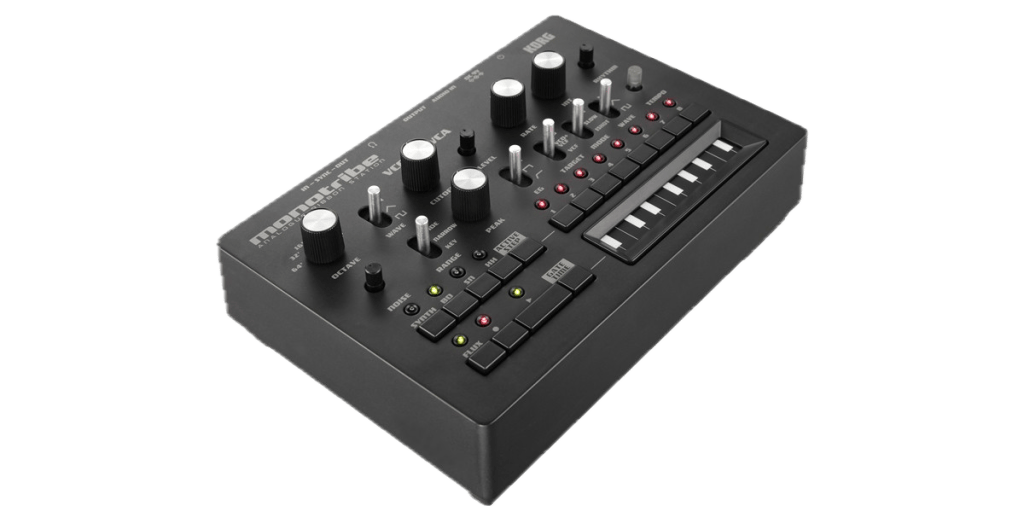
KORG monotribe and Analog Synthesizers
Rapunzel Electronics:
At the time, analog synthesizers weren’t nearly as commonplace as they are now.
Of course, some were still being made here and there.
Then KORG released the monotron, this tiny, almost toy-like analog synthesizer that would make these little beeeepsounds.
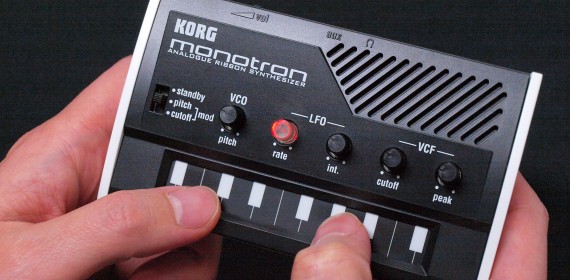
From there, KORG gradually started putting more effort into analog synthesizers, and eventually the monotribe came out.
When that happened, I thought,
“Ah, I guess I have to start buying gear again.”
So I started buying analog synthesizers again.
The volca series came out shortly afterwards too.
I assume everyone knows the volca series?
It’s an extremely famous series, so I strongly recommend keeping at least one—or perhaps several—within reach.
The Gear Most Frequently Used in His Music
Tsubasa Arakawa:
Out of all the equipment you own, is there anything you’re particularly attached to, or anything you use especially often in your actual productions?
Rapunzel Electronics:
There are machines that I’m emotionally attached to but don’t actually use, and then there are machines I’m not especially attached to but use constantly.
I imagine many of the people reading this listen to EMLF, and almost all the rhythms in the tracks I’ve released through EMLF were made with the KORG volca sample.
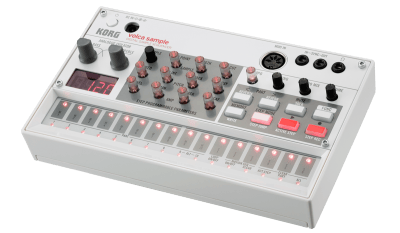
I’m using that little sampler to play the rhythms.
Tsubasa Arakawa:
I didn’t realize that.
Rapunzel Electronics:
They’re relatively affordable on the second-hand market, so maybe everyone should try buying a few.
It might be pretty entertaining if you lined up a whole bunch of them.
Tsubasa Arakawa:
At that point, you’d be building quite a large-scale system.
Going with Elektron gear might also become an option.
Future Activities
Tsubasa Arakawa:
So what kind of activities would you like to pursue in the future?
Rapunzel Electronics:
I’d like to be active.
I want to continue properly making and releasing things.
Tsubasa Arakawa:
What specifically would you like to do?
Rapunzel Electronics:
As naturally as possible, I want to take whatever comes out of me and release it directly as music.
I don’t want to overthink things. I just want to keep making music.
At the same time, I hope each individual track has something in it that catches people’s attention.
I’m not the kind of person who starts out thinking,
“I’m going to make this kind of masterpiece.”
Of course, there are countless masterpieces that were meticulously planned and created over long periods of time.
But that isn’t really how I work.
I’m not someone with an extraordinary knowledge of music theory either.
I’m simply sitting there in the middle of the night playing a rhythm machine.
It’s something I’ve been doing ever since high school.
Then I put some strange sound on top of it and reach that moment where I think,
“Ah, that’s it. It’s finished.”
That moment is really enjoyable.
If I make something because I enjoyed making it, and other people hear it and say, “Hey, this is interesting,” that makes me happy.
That’s basically how I see it.
“I Want Everyone to Become a Player”
Rapunzel Electronics:
And another thing: if possible, I want everyone to become a techno player.
Tsubasa Arakawa:
Everyone?
Rapunzel Electronics:
Yes.
Take the automobile industry, for example. It’s an enormous industry.
And when it comes to musical instruments, an incredible number of guitars are sold.
Compared with that, I think synthesizers and rhythm machines still represent a relatively small market.
So I want more synthesizers and rhythm machines to be sold.
I’d like electronic musical instruments themselves to become a much larger industry.
Tsubasa Arakawa:
So it’s not only the music scene itself—you’d also like to see the equipment market grow.
Rapunzel Electronics:
Exactly.
Everyone, please buy gear.
If more gear sells, manufacturers will produce a greater variety of instruments, and that makes me happy too.
So I’d like all kinds of manufacturers to develop more electronic instruments.
CASIO
Rapunzel Electronics:
CASIO has been putting in a lot of effort recently too.
They released a sampler recently, didn’t they?
I’d really like people to try it out.
Although I personally haven’t had the chance to explore it in depth yet.
Tsubasa Arakawa:
I tried it briefly, and it was very interesting.
Rapunzel Electronics:
I didn’t experience the era of CASIO’s CZ and FZ instruments in great detail firsthand, but with modern CASIO I get this feeling of, “Let’s bring back the glory days.”
So I’d like everyone to pay attention to CASIO’s electronic instruments with that feeling in mind too.
Tsubasa Arakawa:
CASIO really has been putting a lot of effort into electronic instruments recently.
I’m wearing a G-SHOCK right now myself, but CASIO has always made interesting products.
Rapunzel Electronics:
CASIO is techno, isn’t it?
Tsubasa Arakawa:
There definitely is something about it that feels techno.
Casiotone instruments are also regularly used in electronic music.
Rapunzel Electronics:
Exactly.
I’d like Japanese electronic instrument manufacturers such as CASIO, KORG, and Roland to keep developing new things.
And I want lots of people to use them.
Of course, I also want small garage manufacturers all over the world to thrive.
MFB
Rapunzel Electronics:
Can I talk about one more piece of gear?
This is going to sound a little like something from Sound & Recording Magazine.
There was a German manufacturer called MFB, and I really liked their rhythm machines. I spent a lot of time playing around with them.
The founder passed away, and as far as I know the company is no longer operating in the same form as it once did.
I believe there was some talk about his son continuing the company, but I haven’t kept up with what happened after that.
They were a really great manufacturer, so if you ever come across second-hand MFB equipment, I definitely recommend trying it.
Tsubasa Arakawa:
MFB was the company that made machines such as the Tanzbär, right?
Rapunzel Electronics:
Exactly.
Although I never owned a Tanzbär itself.
The ones I owned were machines with sounds somewhat like an 808 and another with sounds somewhat like a 909.
The MFB-503 and MFB-522, around that range.
Tsubasa Arakawa:
Did you use those in your own productions as well?
Rapunzel Electronics:
I used them quite a lot.
Although I may not have used them very much on the material I’ve released through EMLF.
Quasimidi Polymorph
Tsubasa Arakawa:
On the release coming out on September 25, you also used a rather unusual synthesizer, didn’t you?
Rapunzel Electronics:
I did.
I completely forgot the manufacturer’s name for a moment—the company that made the Rave-O-Lution 309…
Tsubasa Arakawa:
Quasimidi.
Rapunzel Electronics:
Right, Quasimidi.
My Rave-O-Lution 309 itself is broken, so I don’t use it anymore, but for this release I used another Quasimidi instrument called the Polymorph, which is quite a rare synthesizer.
The sound that goes byoi-byoi in the tracks is probably the Polymorph.
Tsubasa Arakawa:
It’s quite a substantial synth physically as well.
It has a presence comparable to something like an Elektron Analog Four MK2.
Rapunzel Electronics:
About that size, perhaps.
It has a sequencer, and you can do all kinds of strange things with it.
It makes strange sounds.
And then you can loop those strange sounds.
That’s why it’s a good instrument.
Tsubasa Arakawa:
That sounds like a very Rapunzel Electronics way of evaluating a synthesizer.
Rising Gear Prices
Rapunzel Electronics:
The problem these days is that musical instruments have simply become extremely expensive.
Tsubasa Arakawa:
They really have.
There are probably a number of factors behind it, including the weak yen and rising prices in general.
Rapunzel Electronics:
I really don’t think it’s a good situation.
The fact that younger people are finding it increasingly difficult to buy musical instruments and computers is quite a serious problem.
Tsubasa Arakawa:
The barrier to entering a creative environment is becoming higher.
Rapunzel Electronics:
Well, when it comes to creativity itself, you can still find a way if you’re inventive enough.
In the most extreme case, simply hitting everyday objects can create a rhythm.
If I were somehow transported back in time, I think I’d like to become someone who made music using nothing but whatever was around me—wood, bones, things like that.
The Current Club and Electronic Music Scene
Tsubasa Arakawa:
Next, is there anything you feel about the current club or electronic music scene?
Rapunzel Electronics:
I’ve become an older guy myself now, so my feeling is basically:
“Please let me join you.”
When I actually go to clubs, there are still people my age and people older than me.
But as you get older, your friends stop coming out to play with you.
They have children, their lives change, things like that.
That part can be a little lonely.
So I’d like everyone to come out and have fun more often.
Techno Continuing from the 1990s
Rapunzel Electronics:
I’m from the generation that actually experienced techno in the 1990s, so for me, the fact that I’m still making techno now feels completely natural.
But when you really think about it, the 1990s were more than thirty years ago.
Take 1993, for example.
1993 is quite a symbolic year for me, but from the perspective of 2026, it was thirty-three years ago.
And thirty-three years before 1993 was 1960.
Back in the 1990s, I don’t think there were nearly as many young people simply continuing to make music from the 1960s in exactly the same way as there are young people making techno today.
So I find it incredibly interesting that, even in the 2020s, young people are still making techno.
I find myself thinking:
“It’s amazing that young people still discover techno and somehow make their way all the way here.”
Tsubasa Arakawa:
There certainly are a lot more younger DJs now.
The Wider Entry Point into DJing
Tsubasa Arakawa:
This is my own interpretation, but I think part of that has to do with how much easier it has become to get started as a DJ.
Originally, records were the main format.
Then CDJs appeared, followed by laptop DJing.
And another major development was the DJ ecosystem built around rekordbox and USB drives, created by Pioneer DJ, now AlphaTheta.
As long as the venue has compatible CDJs, you can play simply by bringing a USB flash drive.
Creating an environment where people can begin DJing so easily has significantly widened the entry point.
Technological progress has increased the number of people who can actually perform in clubs.
I think that’s a very interesting change.
Rapunzel Electronics:
Are there a lot of young track producers as well?
Tsubasa Arakawa:
I don’t get the impression that there are as many young track producers as there are young DJs.
The skills involved in producing music and the skills involved in DJing don’t necessarily overlap.
People like me, who DJ, produce tracks, and also perform live, are relatively uncommon.
My impression is that there’s a certain division between people who primarily work as DJs and those who focus more on track production or live performance.
I Want Young People to Make Music Too
Rapunzel Electronics:
I genuinely want everyone to make something, even if all they have is an iPad and GarageBand.
Tsubasa Arakawa:
So you’d like younger generations in Japan to release more of their own music?
Rapunzel Electronics:
Exactly.
Sometimes the things that make you think,
“Is something like this really good enough?”
are actually the most interesting.
You don’t have to think that you can’t make something because you don’t know what happened in the past.
There will always be people saying strict things like,
“This genre has certain rules you have to follow.”
But why not just do whatever you want?
If people simply keep making a lot of things, interesting music will eventually emerge from among them.
So rather than worrying too much about whether something is polished enough, I’d like people to just keep making and releasing things.
Tsubasa Arakawa:
So the important thing is to first take on the challenge of making something at all?
Rapunzel Electronics:
Exactly.
Human Beings Seek Loops
Rapunzel Electronics:
Can I talk about something really fundamental?
Tsubasa Arakawa:
Of course.
Rapunzel Electronics:
I think human beings like loops.
Tsubasa Arakawa:
I imagine musical preferences vary from person to person.
Rapunzel Electronics:
No, I mean in a more biological sense.
There’s the rhythm of a day, and the rhythm of a year.
We live our entire lives looping through all kinds of cycles.
For example, if you hear:
Boom, boom, boom…
you expect another boom on the fourth beat, right?
That means human beings are anticipating a loop.
But if you get:
Boom, boom, boom… tchak!
you suddenly think:
“What?”
That surprise is essentially what happens when you put a fill into the eighth bar, for example.
That sense of expecting repetition, combined with the pleasure of deviating slightly from that repetition, is one of the most fundamental aspects of techno.
And it’s something you can share with someone from another country without exchanging a single word.
So basically, what I’m saying is:
Loops are fun.
Tsubasa Arakawa:
I think your own work is particularly unique in the way it gradually changes within those loops.
Rapunzel Electronics:
That kind of thing is difficult to do in many other forms of music.
What He Wants to Do with EMLF
Tsubasa Arakawa:
Finally, there’s something I’d personally like to ask.
Is there anything you would like to do in the future through EMLF, either as a label or as a media platform?
Rapunzel Electronics:
Well, eventually I’m going to make EMLF mine.
Tsubasa Arakawa:
You mean take it over?
Rapunzel Electronics:
Exactly. I’m going to take it over.
And then I’ll employ Tsubasa Arakawa.
Tsubasa Arakawa:
So I’ll become the employee.
It sounds like I may end up in an even harsher position than I’m in now.
Rapunzel Electronics:
We’ll make sure you work properly.
Tsubasa Arakawa:
I don’t know whether that will actually happen, but for the time being, I’d be very happy if you could continue helping us build EMLF together.
Rapunzel Electronics:
Let’s keep building it.
And not only EMLF—I’d like to help energize the music scene as a whole.
Tsubasa Arakawa:
Absolutely.
Closing
Tsubasa Arakawa:
With that, I think we’ll bring our interview with Rapunzel Electronics to a close.
Rapunzel Electronics’ new EP is scheduled for release through EMLF on September 25.
We’re extremely happy with how this release has turned out, and I hope everyone will take the time to listen to it.
We sincerely appreciate your continued support for both Rapunzel Electronics and EMLF.
Thank you very much for joining us today.
Rapunzel Electronics:
Thank you very much.
And please subscribe to the channel too—if there is a channel.
Tsubasa Arakawa:
Yes, including all of that, we hope you’ll continue supporting us in the future.
